

For brands and OEM buyers developing wearable devices, handheld electronics, or smart consumer products, haptic performance is no longer a minor detail. A well-matched linear resonant actuator can improve response speed, vibration clarity, perceived product quality, and even long-term power efficiency. This is why more product teams are replacing traditional ERM motors with LRA solutions in performance-driven applications.
Why haptic performance matters in modern electronic products
In an era where user experience defines brand loyalty, haptic feedback has evolved from a simple "vibration alert" to a core differentiator for electronic products. Consumers and B2B buyers alike now expect tactile interactions that feel intentional, clear, and reliable—whether it’s a subtle keypress confirmation, a precise alarm for a health monitor, or a immersive gaming vibration. Poor haptics can lead to user frustration, missed alerts, and a perception of low-quality design, while refined feedback boosts engagement, trust, and perceived value.
From basic vibration to premium user feedback
Traditional ERM motors deliver a one-size-fits-all vibration that often feels muddy or delayed, limiting the range of user experiences they can support. Custom linear resonant actuator(LRAs), by contrast, enable nuanced, context-aware feedback: a light tap for a text message, a distinct pattern for a navigation alert, or a strong rumble for a game event. This level of customization turns passive interactions into immersive, intuitive experiences, helping products feel more premium and user-centric.
Why B2B buyers now care more about response quality and efficiency
For OEMs and product managers, haptic performance isn’t just about user satisfaction—it’s tied to critical business metrics. Slow, inconsistent vibrations can lead to user error in medical devices, reduced battery life in wearables, and lower retention rates for consumer electronics. B2B buyers are increasingly prioritizing LRAs because they deliver faster response times, lower power consumption, and longer lifespans, directly aligning with the goals of building reliable, long-lasting products that drive repeat business.
What makes LRA different from traditional ERM motors
While both ERM motors and LRAs produce vibration, their underlying mechanics and performance characteristics are fundamentally distinct. These differences directly impact how they perform in real-world applications, making LRAs the preferred choice for products that demand precision, efficiency, and clarity.
Single-axis vibration and cleaner tactile feedback
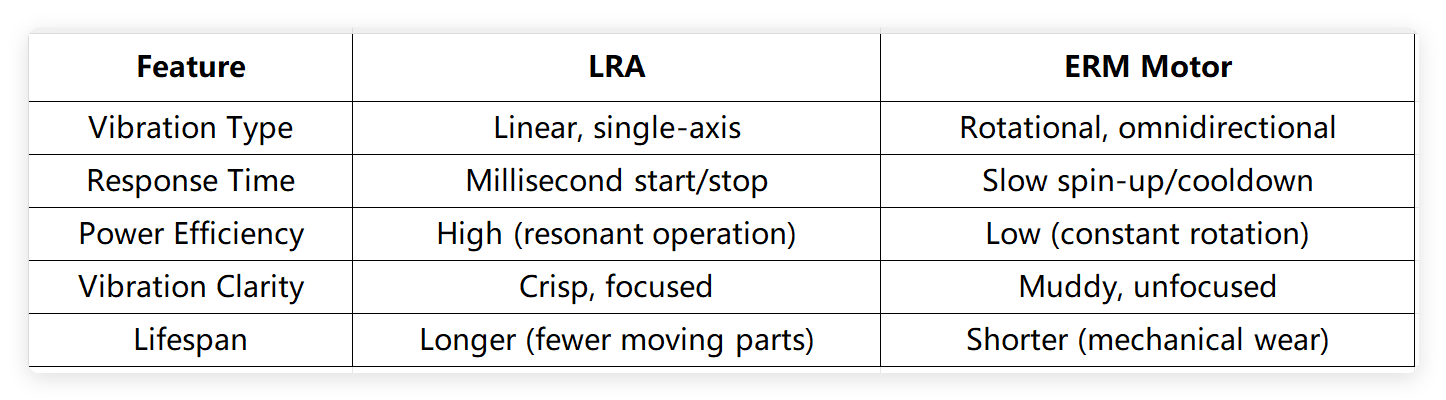
ERM motors use an eccentric rotating mass to create vibration, resulting in omnidirectional, often distorted movement that can feel "fuzzy" or unfocused. LRAs, on the other hand, generate linear, single-axis vibration through a resonant mass, producing crisp, well-defined feedback that users can easily distinguish. This clarity is essential for applications where precise tactile cues are critical, such as accessibility features or medical device alerts.
Faster start-stop response for more precise interaction
One of the most impactful advantages of LRAs is their near-instant start-stop response time. Unlike ERM motors, which take time to spin up and slow down, LRAs can activate and deactivate in milliseconds, enabling ultra-precise interactions like virtual keyboard clicks, gaming triggers, or real-time health alerts. This responsiveness makes devices feel more "alive" and connected to user input, a key factor in modern user experience design.
Lower power consumption and longer operating life
LRAs operate at resonance, which means they use significantly less power to produce the same vibration intensity as ERM motors—critical for battery-powered devices like smartwatches and wireless earbuds. Additionally, their solid-state design (with fewer moving parts) reduces wear and tear, leading to longer operating lifespans and lower replacement costs over the product lifecycle.
How LRA improves product performance in real applications
The benefits of LRAs aren’t just theoretical—they translate to tangible improvements across a wide range of consumer and industrial products. From touchscreen devices to medical tools, LRAs elevate performance by delivering more reliable, intuitive, and efficient haptic feedback.
Better input confirmation in touch-based devices
For smartphones, tablets, and touchscreen wearables, LRAs provide immediate, tactile confirmation of user inputs (like button presses or swipes) that mimics the feel of physical keys. This reduces input errors, speeds up interaction, and makes touch interfaces feel more responsive and satisfying, directly improving user productivity and satisfaction.
More effective alerts in wearable and handheld products
Wearable devices like fitness trackers and smartwatches rely on haptics to deliver non-intrusive alerts. LRAs’ precise, adjustable vibration patterns allow for clear differentiation between notifications (e.g., a light tap for a calendar reminder vs. a stronger pulse for an emergency call), ensuring users never miss critical information while avoiding unnecessary disruptions.
Improved perceived quality in premium consumer electronics
Premium brands use 8mm linear vibration motor for compact devices to signal craftsmanship and attention to detail. A smartphone with crisp, responsive haptics feels more luxurious than one with generic vibration, even if other specs are similar. This perceived quality boosts brand reputation and allows companies to command higher price points in competitive markets.
Higher consistency in medical and personal care devices
In medical devices like glucose monitors or physical therapy tools, consistent, reliable haptic feedback is a matter of safety and effectiveness. LRAs deliver uniform vibration intensity and timing, ensuring users receive accurate, repeatable cues—whether it’s a reminder to take medication or a signal to adjust a therapy device—without the variability that can come with ERM motors.
The ROI of upgrading from ERM to LRA
Upgrading to LRAs isn’t just a technical choice—it’s a strategic investment that delivers measurable returns for product teams and OEMs. By focusing on business outcomes rather than technical jargon, it’s clear that the long-term benefits far outweigh the initial cost of adoption.
Reduced power draw in battery-powered devices
For battery-powered products, lower power consumption directly translates to longer battery life—a top selling point for consumers. LRAs use up to 50% less power than ERM motors for equivalent vibration, meaning smartwatches, wireless earbuds, and other wearables can go longer between charges, reducing user frustration and increasing product satisfaction.
Longer lifespan and lower replacement risk
LRAs’ robust design minimizes mechanical failure, reducing warranty claims and product recalls. For industrial and medical devices, this means fewer service calls and lower maintenance costs, while for consumer electronics, it builds trust that the product will perform reliably for years, boosting brand loyalty and reducing churn.
Stronger product differentiation through better haptics
In crowded markets, haptic performance is a unique selling proposition that sets products apart. Brands that adopt LRAs can market their devices as "more responsive," "more intuitive," or "more premium," creating a clear competitive edge that resonates with both consumers and B2B buyers.
Why better feedback can improve user retention and product value
High-quality haptic feedback increases user engagement and retention. Users are more likely to stick with a device that feels responsive and intuitive, leading to higher repeat purchases and positive word-of-mouth. Over time, this builds a loyal customer base and increases the overall lifetime value of each product.
What can limit LRA performance if the design is not matched correctly
While LRAs offer significant advantages, their performance is highly dependent on proper integration into the product design. Poorly matched components or mounting can negate many of their benefits, leading to subpar haptics, reduced efficiency, and even premature failure.
Resonance frequency mismatch
LRAs are tuned to a specific resonant frequency, and any mismatch between the actuator and the product’s housing or mounting structure can dampen vibration intensity or cause unwanted noise. This is why it’s critical to work with suppliers to test and optimize the LRA for the product’s unique form factor early in the design process.
Driver and control strategy issues
The LRA’s performance is only as good as its driver and control software. Inadequate drive voltage, incorrect waveform generation, or poor timing algorithms can lead to slow response times, distorted vibration, or excessive power consumption. Investing in high-quality drivers and custom control strategies is essential to unlock the full potential of LRAs.
Mounting method and housing structure effects
How the LRA is mounted to the product’s frame or housing directly impacts vibration transfer. Rigid mounting can amplify vibration, while loose or flexible mounting can muffle it. Additionally, the housing’s material and thickness can affect how vibration is perceived by the user, requiring careful prototyping and testing to achieve the desired tactile feel.
Why prototype testing matters before volume production
Before committing to mass production, thorough prototype testing is non-negotiable. This allows product teams to identify and resolve issues like resonance mismatch, mounting problems, or control strategy flaws early, avoiding costly rework and ensuring the final product delivers the intended haptic performance. Testing with real users also provides valuable feedback on how the vibration feels in practice, helping to refine the design further.
How to evaluate LRA options for your next project
Choosing the right LRA for your product requires a structured approach that aligns with your performance goals, form factor, and budget. By focusing on key evaluation criteria, you can select an actuator that delivers the best possible haptic experience while meeting your technical and business requirements.
Confirm vibration target, size, and mounting style
Start by defining your core haptic needs: What vibration intensity and frequency do you need? How much space is available in the product? What mounting method (surface-mount, through-hole, etc.) is compatible with your design? These parameters will narrow down the pool of potential LRA suppliers and models to those that fit your specific use case.
Review lifecycle, consistency, and production capability
Evaluate the LRA’s expected lifespan, vibration consistency across temperature and usage, and the supplier’s production capacity. Look for suppliers with a track record of delivering high-quality, reliable components, and ask for data on failure rates and performance consistency to ensure the actuator will perform as intended over the product’s lifecycle.
Ask for samples and application-specific recommendations
Request samples from shortlisted suppliers to test in your prototype, and work with their engineering teams to get application-specific recommendations. Reputable suppliers will provide guidance on tuning the LRA to your product’s design, optimizing control strategies, and avoiding common integration pitfalls—ensuring you get the best possible performance from a micro vibration motor manufacturer.
When LRA is the right choice for performance-focused products
For product teams and OEMs building devices where response speed, tactile clarity, and reliability are non-negotiable, linear resonant actuators are the clear choice. From extending battery life in wearables to creating immersive user experiences in consumer electronics, LRAs deliver tangible improvements that drive user satisfaction, brand loyalty, and long-term business value.
For projects where response, feel, and reliability all matter
If your product demands precise, responsive haptic feedback, lower power consumption, and a long operating lifespan, upgrading to LRA is an investment that will pay off in better user experiences and stronger market performance. By working with experienced suppliers and prioritizing proper integration, you can unlock the full potential of haptic technology and create products that stand out in today’s competitive landscape.
Come on! Contact our engineering team right now!
Consult Your Leader Experts
We help you avoid the pitfalls to deliver the quality and value your micro brushless motor need, on-time and on budget.
Post time: Mar-27-2026


