

Introduction: Why Does a Door Lock Need a Vibration Motor?
Smart door locks are becoming more intelligent, compact, and interactive. Fingerprint recognition, PIN codes, mobile apps, NFC, Bluetooth, and other access technologies have transformed the traditional door lock into an integrated electronic device.
But there is still one important question:
How does the user know that the command was successfully completed?
A visual indicator or smartphone notification is not always enough. When a user enters a PIN, touches a fingerprint sensor, locks the door, or attempts an unauthorized operation, a short and precise vibration can provide immediate physical feedback.
This is where a vibrator motor for door lock can add significant value.
A miniature vibration motor can be integrated into the lock housing or control panel to provide haptic feedback for events such as:
- Successful unlocking
- Successful locking
- Incorrect PIN or fingerprint
- Low-battery warning
- Unauthorized access attempt
- Door status confirmation
- System or maintenance alerts
It is important to distinguish the two functions: the actuator motor moves the lock mechanism, while a vibration motor communicates information to the user through tactile feedback. In a well-designed smart lock, both can work together.
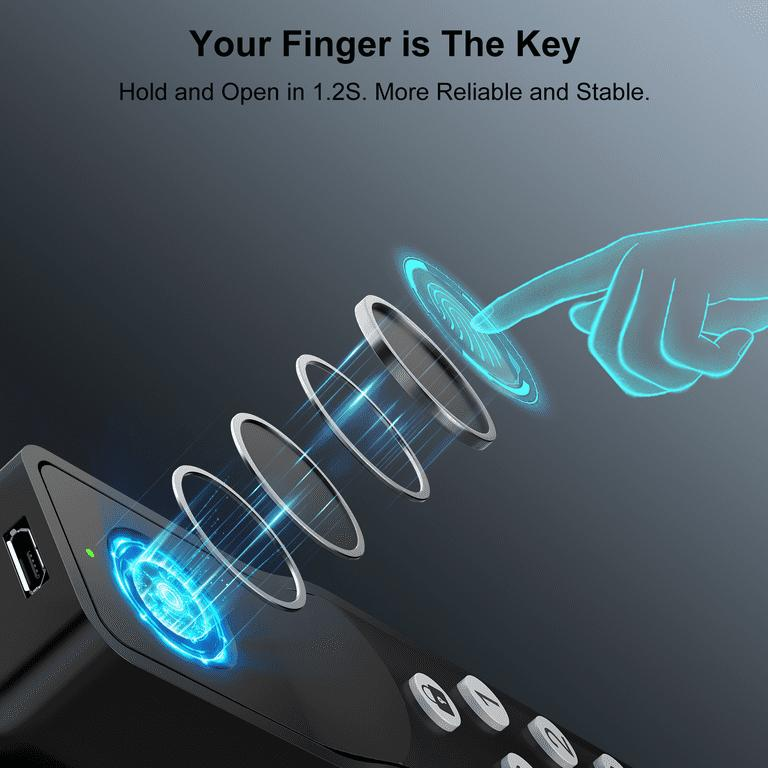
Why Use a Vibrator Motor in a Door Lock?
A small vibration motor does more than simply make a product vibrate. Properly selected, it can become part of the smart lock's human-machine interface.
1. Immediate Lock and Unlock Confirmation
One of the simplest applications is providing confirmation after an operation.
For example:
Short vibration → Lock command accepted
Double vibration → Unlock command accepted
Longer vibration → Warning or abnormal condition
This allows manufacturers to create different vibration patterns for different system events.
For compact consumer electronics, vibration feedback is already widely used because it communicates information without requiring a display or audible sound.
2. Silent User Feedback
Smart locks are often installed in bedrooms, hotels, offices, apartments, and other environments where excessive sound is undesirable.
Compared with a buzzer, vibration feedback can provide a more localized user experience.
For example:
Enter PIN → Fingerprint verified → Door unlocked → Gentle vibration
The user receives confirmation without creating unnecessary noise.
This is particularly useful for:
- Hotel rooms
- Bedrooms
- Office doors
- Apartment entrances
- Meeting rooms
- Private spaces
3. Low-Battery and Security Alerts
A smart lock can use different vibration patterns to communicate different system states.
|
Event |
Possible Haptic Pattern |
User Meaning |
| Unlock successful | 1 short pulse | Access granted |
| Lock successful | 2 short pulses | Door secured |
| Wrong PIN | 2–3 pulses | Authentication failed |
| Low battery | Repeated pulses | Battery replacement required |
| Unauthorized attempt | Stronger/longer pattern | Security warning |
| System error | Long pulse | Check lock status |
The exact pattern should be determined by the product designer based on the lock's user interface and control algorithm.
ERM vs. LRA: Which Vibration Motor Is Better for Smart Locks?
The two most common miniature vibration technologies for haptic feedback are ERM (Eccentric Rotating Mass) and LRA (Linear Resonant Actuator).
Quick Comparison
| Feature | ERM Vibration Motor | LRA Vibration Motor |
| Operating principle | Rotating eccentric mass | Resonant linear movement |
| Control | Simple | More precise |
| Response | Moderate | Fast |
| Haptic precision | Good | Excellent |
| Noise | Moderate | Low |
| Vibration patterns | Basic | More controllable |
| Energy efficiency | Moderate | Generally better for short haptic events |
| Best use | Cost-sensitive products | Premium smart locks |
| Installation | Simple | Requires suitable drive frequency |
For a basic electronic door lock, an ERM motor can be an economical solution.
For a premium smart lock where fast response, low noise, precise feedback, and sophisticated vibration patterns are important, an LRA can be a stronger choice.
LEADER's LRA products are designed specifically for haptic-feedback applications and offer characteristics such as fast response, adjustable vibration force, low noise, and long operating life.
Choosing the Right Vibrator Motor for Door Lock Applications
Selecting a vibration motor should not be based on diameter alone. The motor needs to match the electrical, mechanical, and user-experience requirements of the entire lock.
Smart door locks increasingly use compact PCBs and thin front panels.
A vibration motor that is too large can:
- Increase housing dimensions
- Interfere with the PCB
- Increase assembly difficulty
- Reduce available battery space
Coin vibration motors are particularly useful when installation space is limited.
LEADER currently offers coin vibration motors in approximately 7–12 mm diameter, including different mounting and connection options such as FPCB and lead-wire configurations.
Recommended Design Considerations
| Requirement | Recommended Direction |
| Very limited space | Coin-type vibration motor |
| Thin control panel | Thin coin motor or LRA |
| Premium haptic feedback | LRA |
| Low-cost feedback | ERM |
| Long-term reliability | LRA / BLDC depending on design |
| PCB integration | FPCB / SMT-compatible solution |
| Custom housing | Custom motor + mounting solution |
More vibration does not necessarily mean better feedback.
If the motor is too strong, the user may perceive the feedback as harsh or noisy.
If the vibration is too weak, the user may not notice it.
The ideal vibration force depends on:
- Lock housing material
- Motor mounting position
- Housing thickness
- User contact position
- Desired feedback intensity
- Operating voltage
Therefore, vibration force should be evaluated after the motor is installed in the actual door lock housing, rather than only testing the motor independently.
Smart locks often require immediate feedback.
For example:
Fingerprint recognized → vibration → actuator starts
If the vibration response is slow, the user may feel that the system is unresponsive.
LRA technology is especially suitable for applications requiring fast and precise haptic feedback. LEADER's LD4512AA, for example, specifies a start time of up to 100 ms and stop time of up to 180 ms, with a stated life of 1,000,000 cycles under its specified test condition.
Typical Door Lock Applications
A vibrator motor can be integrated into many types of access-control products.
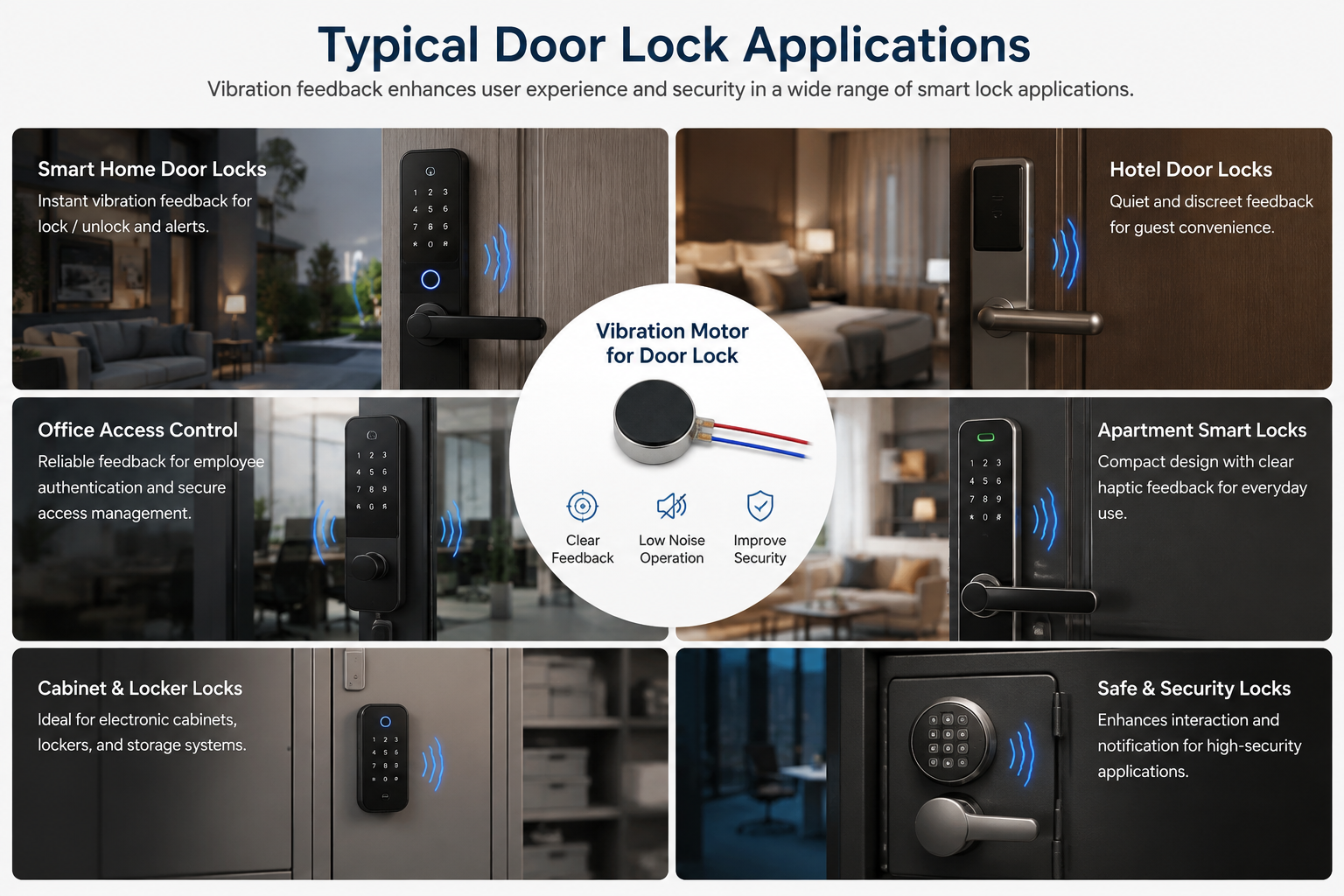
LEADER Vibration Motor Solutions for Smart Door Locks
LEADER specializes in miniature vibration and haptic motor solutions for compact electronic products.
Its product portfolio includes:
- Coin Vibration Motors
- LRA / Linear Resonant Actuators
- Micro BLDC Motors
- Small Vibration Motors
- Custom FPCB and lead-wire configurations
LEADER's current product range includes compact coin motors, LRA motors and miniature BLDC motors in several form factors.
For smart lock applications, engineers can select the motor based on:
Size → Voltage → Vibration Force → Response → Noise → Lifetime → Mounting → Cost
FAQ: Vibrator Motor for Door Lock
A vibrator motor for a door lock is a miniature motor used primarily to provide tactile feedback. It can indicate successful locking, unlocking, authentication, low battery, or abnormal operation.
No. A vibration motor generally provides haptic feedback, while the main smart-lock actuator or gear motor provides the mechanical force needed to move the locking mechanism.
ERM is usually suitable for simple and cost-sensitive feedback. LRA is often preferable when the product requires fast response, precise haptic patterns, low noise, and a premium user experience.
Yes. Coin vibration motors are compact and can be integrated into space-constrained electronic products. They can be used for basic lock-status and authentication feedback.
Motor lifetime depends on motor construction, drive conditions, duty cycle, temperature, mounting, and application. Therefore, the lifetime specification should always be evaluated under the intended operating conditions.
For example, LEADER's LD4512AA LRA specifies 1,000,000 cycles under its stated test condition.
In many OEM applications, yes. Motor type, size, operating voltage, drive method, mounting structure, and vibration characteristics can be optimized according to the product requirements.
Yes. For OEM projects, customization can include motor size, FPCB, wire length, connector, mounting configuration, and other electrical or mechanical requirements.
Consult Your Leader Experts
We help you avoid the pitfalls to deliver the quality and value your micro brushless motor need, on-time and on budget.
Post time: Aug-21-2026


