

When a smartphone vibrates for an incoming call, notification, keyboard tap, or haptic interaction, the effect feels simple—but the technology behind it is surprisingly sophisticated.
A phone vibration motor converts electrical signals into controlled mechanical motion. Over the years, smartphone haptics have evolved from traditional ERM (Eccentric Rotating Mass) motors toward more responsive LRA (Linear Resonant Actuator) solutions, while piezoelectric actuators offer another approach for highly precise, wide-bandwidth haptic feedback.
So, how do phones vibrate? What is the difference between ERM, LRA, and Piezo? And which technology is better for modern smartphones?
This guide from Leader breaks it down for engineers, product designers, and OEM buyers.
How Does a Phone Vibration Motor Work?
The basic process is straightforward:
Electrical Signal → Actuator Movement → Mechanical Vibration → Haptic Feedback
When the phone receives a command—for example, an incoming call or touch interaction—the control circuit sends an electrical signal to the actuator. The actuator converts that signal into mechanical movement, which is transferred through the phone's housing and felt by the user's hand or fingers.
The actual mechanism depends on the actuator technology.
|
Technology |
How It Creates Vibration |
Typical Haptic Character |
| ERM | Rotates an eccentric mass | Strong, general-purpose vibration |
| LRA | Moves a mass linearly at resonance | Fast, crisp, precise vibration |
| Piezo | Deforms a piezoelectric element | Very fast, precise, wide-bandwidth feedback |
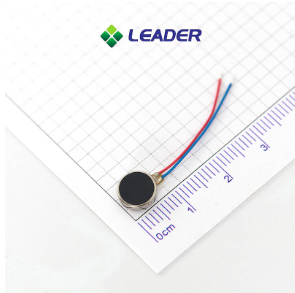
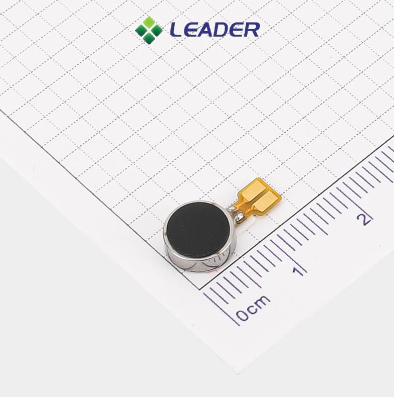
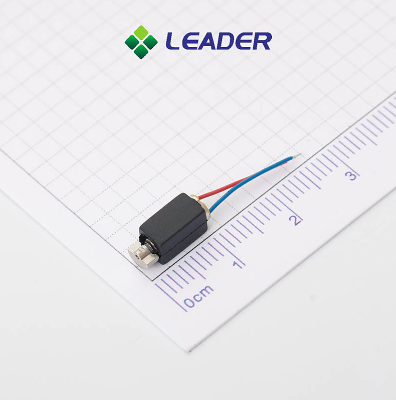
1. ERM: The Traditional Phone Vibration Motor
ERM stands for Eccentric Rotating Mass.
It is one of the simplest and most established vibration technologies. An ERM coin vibration motor uses a small unbalanced mass attached to a rotating shaft.
When the motor spins, the eccentric weight generates centrifugal force. Because the mass is off-center, the resulting force produces vibration.
How ERM Works
DC Power → Motor Rotation → Eccentric Mass → Vibration
ERM motors can be compact, inexpensive, and relatively easy to drive, which made them widely used in earlier generations of mobile phones and other consumer electronics.

Advantages of ERM
- Simple mechanical structure
- Cost-effective
- Easy DC driving
- Strong general-purpose vibration
- Mature manufacturing technology
- Available in compact coin and cylindrical formats

Limitations of ERM
The main limitation is that the vibration is directly related to motor speed.
Because the eccentric mass must accelerate and decelerate, ERM motors generally have slower start/stop behavior than newer haptic technologies. The vibration also tends to feel less precise for short, localized haptic effects.
Best suited for: basic alerts, cost-sensitive devices, wearables, and applications where advanced haptic effects are not the primary requirement.
2. LRA: Why Modern Phones Use Linear Vibration Motors
LRA stands for Linear Resonant Actuator.
Instead of rotating an eccentric weight, an LRA uses a moving mass, spring, and electromagnetic coil. The mass moves back and forth along a defined axis.
AC Signal → Electromagnetic Force → Mass Movement → Linear Vibration
This gives linear resonant actuator a more controlled and directional vibration compared with traditional ERM designs. LRAs are widely associated with modern smartphone haptics and other devices requiring fast tactile feedback.
LRA Requires Resonance
There is one important engineering consideration: an LRA is designed to operate around its resonant frequency. If the drive frequency moves too far away from the actuator's resonance point, vibration output can decrease significantly. This is why an appropriate haptic driver and resonance tracking strategy are important in product development.
Why LRA Is Attractive for Smartphones

- The biggest advantage is response speed and haptic precision.A well-designed LRA can produce short, clearly defined vibration pulses. This makes it suitable for:
- Keyboard feedback
- Touch interactions
- Incoming calls and notifications
- System UI feedback
- Camera controls
- Gaming
- Gesture feedback

3. Piezo: An Alternative for High-Precision Haptics
Piezoelectric actuators work differently from both ERM and LRA.
Instead of using a rotating mass or electromagnetic moving mass, piezo technology uses the piezoelectric effect. Applying an electrical signal causes the piezoelectric material to deform, producing mechanical displacement.
Electrical Signal → Piezoelectric Deformation → Mechanical Movement → Haptic Feedback
Piezo actuators can provide extremely fast response and a wider frequency range, making them attractive for applications requiring more complex haptic waveforms and highly localized feedback.
ERM vs LRA vs Piezo: Which Is Better?
There is no single winner for every product. The right technology depends on the required haptic quality, response time, size, power architecture, cost, and control requirements.
|
Feature |
ERM |
LRA |
Piezo |
| Motion | Rotational | Linear | Piezoelectric deformation |
| Response | Slower | Fast | Very fast |
| Haptic precision | Basic | High | Very high |
| Frequency range | Relatively broad | Resonance-dependent | Broad |
| Drive complexity | Low | Medium | High |
| Typical cost | Low | Medium | Higher |
| Thin-device potential | Good | Good | Excellent |
| Best for | Basic alerts | Smartphone haptics | Advanced haptics |
Why Are LRAs a Popular Choice for Smartphones?
For smartphone OEMs, the LRA sits at an attractive middle ground.
Compared with ERM, it can provide faster and more controlled haptic feedback without requiring the same type of high-voltage piezo drive architecture.
Modern smartphones are also becoming thinner while demanding more sophisticated user interaction. That makes factors such as:
· Fast response · Low noise · Compact size · Directional vibration
· Consistent output · Low power consumption · Precise haptic control
Leader's phone vibration motor solutions include both ERM and LRA technologies, with compact form factors designed for handheld electronics.
ERM vs LRA vs Piezo: Quick Selection Guide
- Cost is a major priority
- You only need basic vibration alerts
- A simple DC drive is preferred
- Complex haptic feedback is unnecessary
- You need fast smartphone haptic feedback
- Precise vibration is important
- Space is limited
- Low noise matters
- You need a mature electromagnetic haptic solution
- Extremely fast response is required
- You need complex haptic waveforms
- Very thin integration is important
- Localized or high-definition haptics are required
- Your system can accommodate more sophisticated drive electronics
What Should OEM Buyers Check Before Choosing a Phone Vibration Motor?
- A short response time is important for keyboard clicks, UI feedback, and other real-time interactions.
ERM, LRA, and piezo actuators have very different electrical requirements. The actuator must be matched with the appropriate driver circuit.
The required vibration force depends on the phone's mass, housing structure, mounting position, and desired user experience.
Mechanical mounting can significantly affect perceived noise. Even a good actuator can produce unwanted sound if the installation structure is poorly designed.
For products receiving thousands of daily interactions, actuator lifetime should be evaluated together with the complete drive system and mounting structure.
Conclusion: The Motor Behind Every Smartphone Vibration
So, how do phones vibrate?
They use a small actuator to transform an electrical signal into mechanical movement—but the technology behind that movement can be very different.
· ERM → simple, economical, proven vibration
· LRA → fast, precise, efficient smartphone haptics
· Piezo → ultra-fast and highly controllable advanced haptics
For many modern smartphone and handheld-device projects, LRA provides a strong balance between performance, size, integration, and cost.
As an experienced micro vibration motor manufacturer, Leader provides ERM, LRA, coin vibration motors, and other customized vibration solutions for OEM and ODM applications.
Modern smartphones commonly use LRA linear vibration motors, while ERM motors have historically been widely used for basic vibration alerts. The exact actuator depends on the phone design and generation.
For advanced smartphone haptics, LRA generally offers better response and more precise tactile feedback than traditional ERM. ERM remains attractive where simplicity and cost are more important.
An LRA operates around its mechanical resonance, so the drive signal needs to be appropriately controlled. A dedicated haptic driver can help generate the required waveform and, depending on the system, track resonance for consistent performance.
Yes. Leader develops micro vibration motors and LRA linear vibration motors for OEM applications, with different sizes, connection methods, mounting options, and performance requirements available for customized projects.
Consult Your Leader Experts
We help you avoid the pitfalls to deliver the quality and value your micro brushless motor need, on-time and on budget.
Post time: Feb-15-2025


