

Introduction
Every smartphone vibrates, but not every smartphone delivers the same tactile experience. Apple’s Taptic Engine has become one of the defining features of the iPhone, creating subtle, precise, and responsive haptic feedback that feels more like a gentle tap than a traditional vibration.
Unlike conventional eccentric rotating mass (ERM) motors, the Taptic Engine is based on Linear Resonant Actuator (LRA) technology. By operating at its resonant frequency, an LRA produces rapid acceleration and deceleration, enabling highly accurate vibration patterns with lower power consumption and reduced noise.
Whether you're designing smartphones, wearables, medical devices, or gaming controllers, understanding how the Taptic Engine works provides valuable insight into modern haptic technology—and why LRAs have become the preferred choice for premium electronic products.
Key Takeaways
- Apple’s Taptic Engine uses Linear Resonant Actuator (LRA) technology.
- LRA motors respond much faster than traditional ERM vibration motors.
- Precise haptic feedback enhances user interaction and perceived product quality.
- LRA motors consume less power and operate more quietly.
- Similar haptic technologies are now widely used in smartphones, wearables, automotive systems, medical devices, and gaming equipment.
- OEM manufacturers can customize LRA motors to meet specific size, frequency, and performance requirements.
What Is Apple's Taptic Engine?
Apple introduced the Taptic Engine to create a more refined tactile experience than conventional vibration motors could provide. Rather than simply shaking the entire device, the Taptic Engine delivers short, precise pulses that simulate the sensation of pressing a physical button or receiving subtle notifications.
The technology first appeared in the Apple Watch and later became a key feature of the iPhone 6s, where it supported the introduction of 3D Touch. Since then, Apple has continuously optimized the Taptic Engine across newer iPhone generations, improving responsiveness, energy efficiency, and haptic precision.
Today, Taptic Engine technology is used in several Apple products, including:
| Apple Product | Haptic Function |
| iPhone | Keyboard feedback, notifications, camera shutter, system gestures |
| Apple Watch | Silent notifications, Digital Crown feedback |
| MacBook | Force Touch trackpad simulation |
| AirPods | Status indication (selected models) |
What Is Haptic Feedback?
Haptic feedback refers to tactile sensations generated by electronic devices to communicate information through touch. Instead of relying solely on visual or audio cues, haptic systems provide physical feedback that enhances user interaction.
Examples include:
- Keyboard clicks
- Camera shutter simulation
- Navigation confirmations
- Gaming effects
- Touchscreen button feedback
Well-designed haptic feedback makes digital interactions feel more natural and intuitive.
Evolution of iPhone Vibration Motors
Apple has continuously improved its vibration technology over the years.
| iPhone Generation | Motor Type | Characteristics |
| iPhone 3G | ERM | Basic vibration |
| iPhone 4 | ERM | Improved durability |
| iPhone 5 | ERM | Better response |
| iPhone 6 | Enhanced ERM | Faster startup |
| iPhone 6s | First Taptic Engine (LRA) | Precise haptics |
| iPhone X | Optimized LRA | Improved responsiveness |
| Latest iPhones | Advanced LRA | Highly refined tactile feedback |
This transition marked a significant leap in user experience, enabling the sophisticated haptic effects users expect today.
ERM vs LRA: What's the Difference?
Although both technologies generate vibration, their operating principles and performance differ substantially.
| Feature | ERM Motor | LRA Motor |
| Response Time | Slow | Very Fast |
| Stop Time | Slow | Instant |
| Accuracy | Moderate | Excellent |
| Power Consumption | Higher | Lower |
| Noise Level | Higher | Lower |
| Frequency Control | Limited | Precise |
| Lifespan | Good | Excellent |
| Haptic Quality | Basic | Premium |
| Suitable Applications | toys, | Smartphones, wearables, medical devices |
For applications requiring high-quality tactile feedback, LRA technology offers clear advantages.
How Does the Taptic Engine Work?
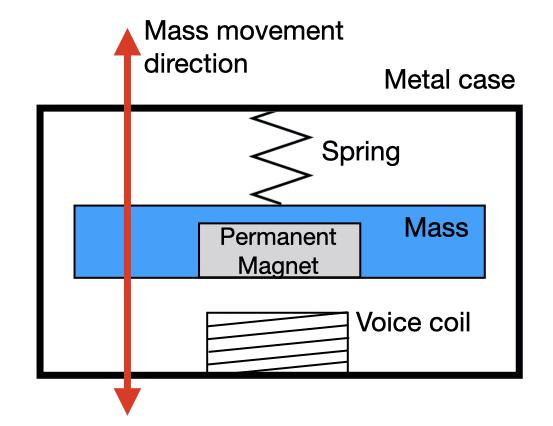
The Taptic Engine operates using a Linear Resonant Actuator. Instead of rotating an off-center weight, it moves a mass back and forth along a single axis.
When alternating current passes through the actuator's voice coil, electromagnetic forces drive the moving mass at its resonant frequency. Springs suspend the mass, allowing it to oscillate efficiently with minimal energy loss.
Because the actuator starts and stops almost instantly, it can generate crisp and highly controlled vibration patterns that closely mimic physical interactions.
Key Components of an LRA
The Taptic Engine operates using a Linear Resonant Actuator. Instead of rotating an off-center weight, it moves a mass back and forth along a single axis.
When alternating current passes through the actuator's voice coil, electromagnetic forces drive the moving mass at its resonant frequency. Springs suspend the mass, allowing it to oscillate efficiently with minimal energy loss.
Because the actuator starts and stops almost instantly, it can generate crisp and highly controlled vibration patterns that closely mimic physical interactions.
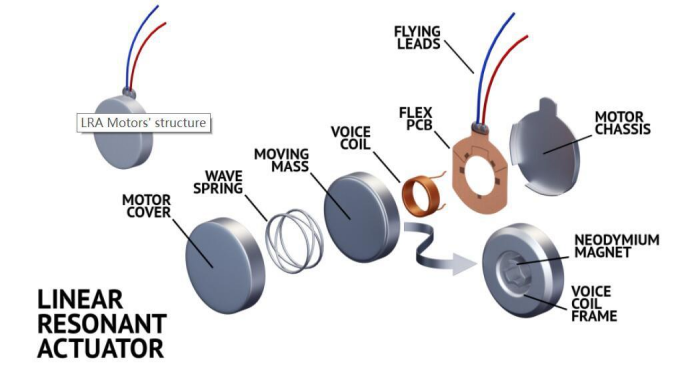
An LRA typically consists of:
Voice Coil: Generates magnetic field
Permanent Magnet: Creates electromagnetic force
Spring System: Maintains resonance
Moving Mass: Produces vibration
Housing: Protects internal structure
Why Apple Chose LRA Instead of ERM
Apple prioritizes user experience, and LRA technology aligns well with that goal.
Key advantages include:
- Faster response
- More accurate vibration control
- Lower energy consumption
- Quieter operation
- Compact design
- Enhanced premium feel
These characteristics enable the subtle tactile effects associated with modern Apple devices.
Typical Specifications of LRA Motors
The following table illustrates representative specifications for compact LRA motors used in consumer electronics.
| Models | Size(mm) | Rated Voltage(V) | Rated Current (mA) | Frequency (Hz) |
Voltage (Vrms) |
Acceleration (Grms) |
| LD0825 | φ8*2.5mm | 1.8VrmsACSine wave | 85mA Max | 235±5Hz | 0.1~1.9 Vrms AC |
0.6Grms Min |
| LD0832 | φ8*3.2mm | 1.8VrmsACSine wave | 80mA Max | 235±5Hz | 0.1~1.9 Vrms AC |
1.2Grms Min |
| LD4512 | 4.0Wx12L 3.5Hmm |
1.8VrmsACSine wave | 100mA Max | 235±10Hz | 0.1~1.85 Vrms AC |
0.30Grms Min |
| LD2024 | Dia 20mmx24T | 1.2VmsAc Sine Wave | 200mA Max | 65±10Hz | 0.1~1.2VrmsAC | 2.5±0.5G |
Applications Beyond Smartphones
Although the Taptic Engine is best known for its role in the iPhone, Linear Resonant Actuators are now used across a wide range of industries.
Common applications include:
· Smartphones
· Smartwatches
· AR/VR headsets
· Gaming controllers
· Medical equipment
· Automotive infotainment systems
· Handheld industrial devices
· Smart home products
As demand for intuitive user interfaces grows, haptic technology continues to expand into new markets.
Choosing the Right LRA Manufacturer
Selecting the right LRA supplier involves more than comparing prices. A reliable manufacturer should provide:
· Custom size options
· Frequency tuning
· Flexible cable and connector configurations
· Engineering support
· Rapid prototyping
· Reliability testing
· ISO-certified manufacturing
· Stable production capacity
For OEM and ODM projects, working with an experienced manufacturer can reduce development time and improve long-term product reliability.
Frequently Asked Questions
1. What is Apple's Taptic Engine?
The Taptic Engine is Apple's proprietary haptic feedback system based on Linear Resonant Actuator (LRA) technology, designed to produce precise tactile sensations.
2. Is the Taptic Engine an LRA?
Yes. The Taptic Engine uses Linear Resonant Actuator technology rather than a traditional rotating vibration motor.
3. Why is LRA better than ERM?
LRA motors provide faster response times, lower power consumption, quieter operation, and more accurate haptic effects.
4. Can Android phones use LRA motors?
Yes. Many premium Android smartphones also use LRA technology to deliver advanced haptic feedback.
5. Does Apple manufacture the Taptic Engine?
Apple designs the overall user experience and specifications, while manufacturing is carried out by specialized component suppliers.
6. What frequency does an LRA motor operate at?
Most compact LRA motors operate around their resonant frequency, commonly in the range of 170–200 Hz, depending on the design.
7. Can LRA motors be customized?
Yes. Manufacturers can customize dimensions, cable types, connectors, mounting methods, resonant frequency, and drive characteristics to suit specific OEM applications.
8. Where are LRA motors commonly used?
They are widely used in smartphones, wearable devices, medical electronics, gaming controllers, automotive systems, and industrial handheld equipment.
Conclusion
Apple's Taptic Engine demonstrates how advanced haptic technology can significantly enhance the user experience. By adopting Linear Resonant Actuator technology, Apple achieved faster response times, greater precision, and improved energy efficiency compared with traditional vibration motors.
As demand for premium tactile feedback continues to grow, LRA technology is becoming the standard choice not only for smartphones but also for wearables, medical devices, automotive systems, and other intelligent electronic products.
For product developers and OEM manufacturers, understanding the principles behind the Taptic Engine provides valuable guidance when selecting the right haptic solution for next-generation devices.
Consult Your Leader Experts
We help you avoid the pitfalls to deliver the quality and value your micro brushless motor need, on-time and on budget.
Working with Us
Post time: Jul-21-2026


