

A modern game controller does much more than transmit button commands.
When a character is hit, a weapon fires, a vehicle crashes, or an explosion occurs, players can feel the event through the controller. This physical feedback adds another layer to the gaming experience and helps connect visual and audio effects with tactile sensations.
At the center of this experience is the game controller vibration motor.
Two technologies are particularly important: ERM (Eccentric Rotating Mass) and LRA (Linear Resonant Actuator).
So, ERM vs LRA — which vibration motor is better for game controllers?
The answer depends on the controller's mechanical structure, desired vibration effects, response requirements, power budget, cost target and overall haptic strategy.
In this guide, we compare ERM and LRA vibration motors and explain why LRA technology is increasingly attractive for high-performance gaming controllers.
Key Takeaways
Before getting into the technical details, here are the main points:
- ERM motors use an eccentric rotating mass to generate vibration.
- LRA motors use a magnet, spring and electromagnetic coil to create linear oscillation.
- ERM is generally simpler and more cost-effective.
- LRA provides faster and more precise haptic feedback.
- LRA can deliver more controlled vibration patterns and lower perceived mechanical noise.
- For basic rumble feedback, ERM can still be a practical solution.
- For premium gaming controllers requiring detailed tactile feedback, LRA is often the stronger choice.
- The right actuator should be selected according to the controller's mechanical design and haptic requirements.
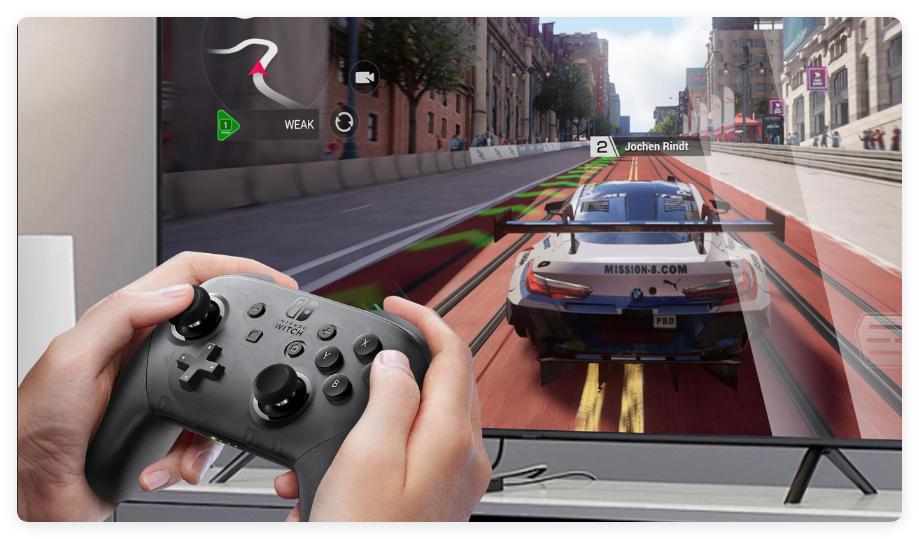
1. What Is a Game Controller Vibration Motor?
A game controller vibration motor is a compact actuator that converts electrical signals into mechanical vibration.
When the game software sends a haptic command, the controller's electronic circuit drives the motor. The resulting vibration is transferred through the controller housing to the player's hands.
This simple mechanism can communicate a surprisingly large amount of information.
For example:
|
Gaming Event |
Possible Haptic Feedback |
| Weapon firing | Short, strong pulse |
| Explosion | Strong low-frequency rumble |
| Vehicle engine | Continuous vibration |
| Collision | Sudden impact |
| Character damage | Short warning pulse |
| Button confirmation | Light tactile click |
| Environmental interaction | Subtle vibration |
| Trigger feedback | Localized tactile response |
The better the actuator can reproduce these different vibration patterns, the more immersive the gaming experience can become.
This is why the selection of a game controller vibration motor is much more than simply choosing a motor with the highest vibration force.
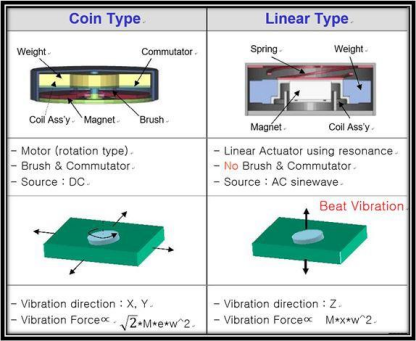
2. ERM vs LRA: How Do They Work?
ERM Vibration Motor
ERM stands for Eccentric Rotating Mass.
An ERM motor uses a rotating shaft with an intentionally unbalanced weight. When the shaft rotates, the eccentric mass generates centrifugal force, producing the vibration felt by the player.
The structure is relatively simple and has been widely used in mobile devices, wearables and game controllers.
How ERM Creates Vibration
Electrical energy → Motor rotation → Eccentric mass movement → Mechanical vibration
The vibration frequency is mainly related to the motor's rotational speed.
This gives ERM motors a useful ability to generate different vibration levels by changing motor speed.
LRA Vibration Motor
LRA stands for Linear Resonant Actuator.
Instead of continuously rotating an eccentric weight, an LRA uses a moving mass, spring and electromagnetic coil. The internal mass oscillates along a defined axis.
How LRA Creates Vibration
Electrical signal → Electromagnetic force → Mass oscillation → Linear vibration
Because the moving mass follows a controlled linear movement, LRA can provide highly responsive and controlled haptic feedback.
LEADER's product information describes LRA motors as actuators that rely on a spring-supported moving mass and notes their advantages for applications requiring fast tactile feedback.
3. ERM vs LRA for Game Controllers
This is the most important comparison for engineers and product designers.
|
Feature |
ERM |
LRA |
| Operating principle | Eccentric rotation | Linear oscillation |
| Vibration control | Moderate | High |
| Response | Relatively slower | Fast |
| Start/stop control | Less precise | More precise |
| Frequency control | Broad through RPM | Resonant frequency focused |
| Haptic detail | Basic to moderate | High |
| Noise | Generally higher | Generally lower |
| Power efficiency | Moderate | Generally better at resonance |
| Mechanical complexity | Simple | More specialized |
| Cost | Lower | Higher |
| Premium haptics | Limited | Excellent |
| Gaming controller use | Basic rumble | Advanced haptic feedback |
In short:
ERM is optimized for simplicity and cost, while LRA is optimized for precision, responsiveness and tactile quality.
4. Response Time: Why It Matters in Gaming
One of the biggest differences between ERM and LRA is how quickly the actuator can respond to a control signal.
In a game, haptic feedback is often synchronized with an event that lasts only a fraction of a second.
For example:
Gunshot → vibration
Impact → vibration
Explosion → vibration
Button press → tactile response
If the vibration starts too late or continues after the event has already finished, the feedback feels less natural.
LRA technology is particularly attractive in these applications because of its fast start-stop characteristics.
LEADER's existing gaming-controller LRA information specifically highlights fast response and synchronization between gameplay events and vibration feedback.
Why Fast Response Improves Haptics
Imagine a racing game.
A vehicle hits a barrier at:
0 ms
The controller should ideally begin its tactile response almost immediately.
The shorter the delay between the game event and the actuator response, the more connected the player feels to the virtual environment.
5. Vibration Quality: ERM vs LRA
Vibration strength is only one part of a good gaming experience.
A more important question is:
Can the controller produce different tactile sensations clearly and consistently?
Consider the difference between these two scenarios.
Basic ERM Feedback
Brrrrrrrrrrrr...
The player feels a general rumble.
Advanced LRA Feedback
Tap → Pulse → Strong impact → Stop
The player can perceive different stages of the event.
This difference becomes especially important in modern games where developers want to create multiple layers of tactile feedback.
LRA's linear movement and controlled operating characteristics make it suitable for applications requiring more refined haptic effects.
6. Noise and Player Comfort
Another important consideration is mechanical noise.
The vibration motor is physically connected to the controller housing. Therefore, the motor's mechanical movement can produce both:
- vibration felt by the hands
- audible mechanical noise
For a gaming controller, excessive motor noise can become distracting, especially when the player is using headphones or playing in a quiet environment.
ERM motors contain a rotating eccentric mass, while LRA motors use linear oscillation. With appropriate mechanical design and control, LRA can provide a smoother tactile experience with lower perceived mechanical noise.
LEADER specifically identifies low noise as one of the design goals of its LD2024 gaming-controller LRA.
7. Why LRA Is Attractive for Premium Gaming Controllers
The gaming industry is moving toward increasingly immersive interaction.
Modern controllers may need to reproduce:
- Different impact intensities
- Short tactile pulses
- Continuous vibration
- Directional or localized effects
- Trigger-related feedback
- Environmental feedback
- Complex vibration sequences
This creates higher requirements for the actuator.
A high-performance LRA motor for game controllers can offer several advantages.
Rapid start and stop behavior allows haptic feedback to closely follow game events.
Linear oscillation provides more controllable tactile feedback.
Appropriate LRA design can help reduce unwanted mechanical noise.
A wider usable frequency range can help create different tactile sensations.
When operated around its resonant characteristics, LRA can provide effective vibration output with relatively efficient energy use.
8. LEADER LD2024: Designed for Gaming Controller Haptics
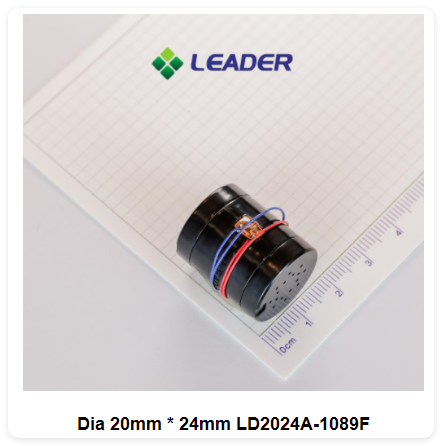
For gaming controllers that require stronger and richer tactile feedback, LEADER offers the LD2024 ultra-wide-frequency LRA.
The LD2024 is a Ø20 mm × 24 mm linear resonant actuator designed for applications requiring stronger haptic output and broader control.
Conclusion: ERM vs LRA for Game Controllers
The vibration motor may be a small component inside a game controller, but it can have a significant influence on the player's experience.
ERM remains a practical solution for controllers that need straightforward and cost-effective rumble feedback.
However, as gaming experiences become more immersive, the requirements for tactile feedback are becoming more demanding.
LRA technology offers advantages in response speed, vibration control, tactile detail and overall haptic performance, making it an attractive solution for premium and next-generation gaming controllers.
For applications requiring stronger and richer tactile feedback, LEADER's LD2024 Ø20 mm LRA provides an example of how a larger linear actuator can be designed specifically around gaming-controller requirements. Its published specifications include 2.5 ± 0.5 Grms vibration force, 65 ± 10 Hz rated frequency, maximum 50 ms rise time and maximum 80 ms fall time.
The right game controller vibration motor is ultimately determined by the experience you want players to feel.
Need a vibration motor for your next gaming controller?
LEADER can help evaluate the required vibration force, frequency, size, voltage, response time and mounting configuration to develop a suitable ERM or LRA solution.
Contact LEADER for your gaming controller vibration motor project.
ERM generates vibration through an eccentric rotating mass, while LRA generates vibration through linear oscillation of an internal mass. LRA generally provides faster and more controlled haptic feedback.
For basic rumble, ERM can be an economical choice. For premium gaming controllers requiring fast, precise and detailed haptic feedback, LRA is generally better suited.
LRA motors offer fast response, controlled vibration and good tactile detail, which makes them suitable for synchronizing haptic feedback with game events.
Gaming controllers can use different actuator technologies, including ERM and LRA. The selection depends on the controller's design, target cost and required haptic experience.
Not necessarily. A larger LRA can provide stronger tactile output, but the best size depends on the controller's available space, mechanical structure and desired vibration performance.
Yes. Motor selection can be evaluated according to dimensions, voltage, vibration force, frequency, response time, mounting method and other application requirements.
Consult Your Leader Experts
We help you avoid the pitfalls to deliver the quality and value your micro brushless motor need, on-time and on budget.
Post time: Nov-23-2024


